Deine Veranstaltungen
in Bonn

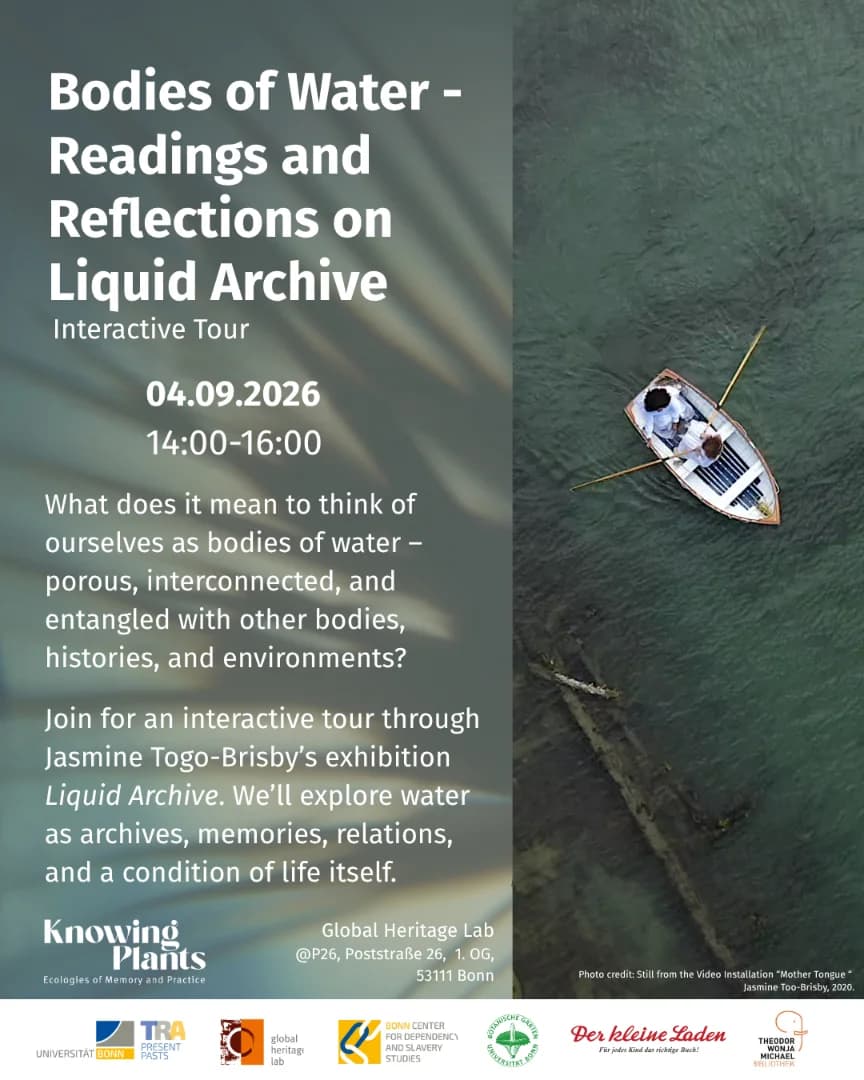
 Ausstellung · Führung
 Fr., 04 Sept. 2026 · 14:00 Uhr
 Global Heritage Lab, Poststraße 26, Bonn 53111
 0.00 € – 4.50 €
Water flows through our bodies and across the planet. Up to 60% of the adult human body is water; before birth, we develop surrounded by amniotic fluid. Water covers 71% of the Earth’s surface. We are, in Astrida Neimanis’ words, bodies of water – connected through water to other bodies, places, histories, and environments. Yet these watery relations are far from equal: access to water is increasingly precarious, shaped by climate change, drought, pollution, and profound inequalities.
In Jasmine Togo-Brisby’s exhibition Liquid Archives, the ocean becomes a protagonist: a body of water that carries histories of colonial exploitation, displacement, and the transoceanic trafficking of human beings, but also a space of memory, connection, and healing.
What changes when we understand ourselves as bodies of water – porous, interconnected, and entangled with other bodies, histories, and environments?
Inspired by Astrida Neimanis’ Bodies of Water: Posthuman Feminist Phenomenology (2017), this interactive tour brings her thinking into dialogue with Togo-Brisby’s works From Bones and Bellies (2021) and Mother Tongue (2020). Together, we explore water as archive, memory, relation, and a condition of life itself.
Organised in cooperation with the Body History Working Group of the Bonn Center for Dependency and Slavery Studies.