Welche Formen des Wissens prägen unsere Beziehung zu Pflanzen und zur Umwelt? Und wie können wir nachhaltige Beziehungen zu ihnen aufbauen?
Die Ausstellung lädt die Besucher:innen dazu ein, sich mit historisch gewachsenen Beziehungen zu Pflanzen, Ökosystemen und Gewässern auseinanderzusetzen und gemeinsam über verantwortungsbewusstere Wege des Umgangs mit der Umwelt nachzudenken.
Im Laufe der vier Jahreszeiten treten Künstler:innen mit familiären Verbindungen zu Chile, Australien und Neuseeland, Nigeria, Mauritius, Indien und Jamaika in einen Dialog mit Forscher:innen der Universität Bonn sowie mit Mitgliedern der städtischen Gemeinschaft. Gemeinsam schaffen sie einen Raum des Lernens und der Begegnung, in dem Fragen der Nachhaltigkeit, der Erinnerung und des Wandels aus transdisziplinären Perspektiven beleuchtet werden.
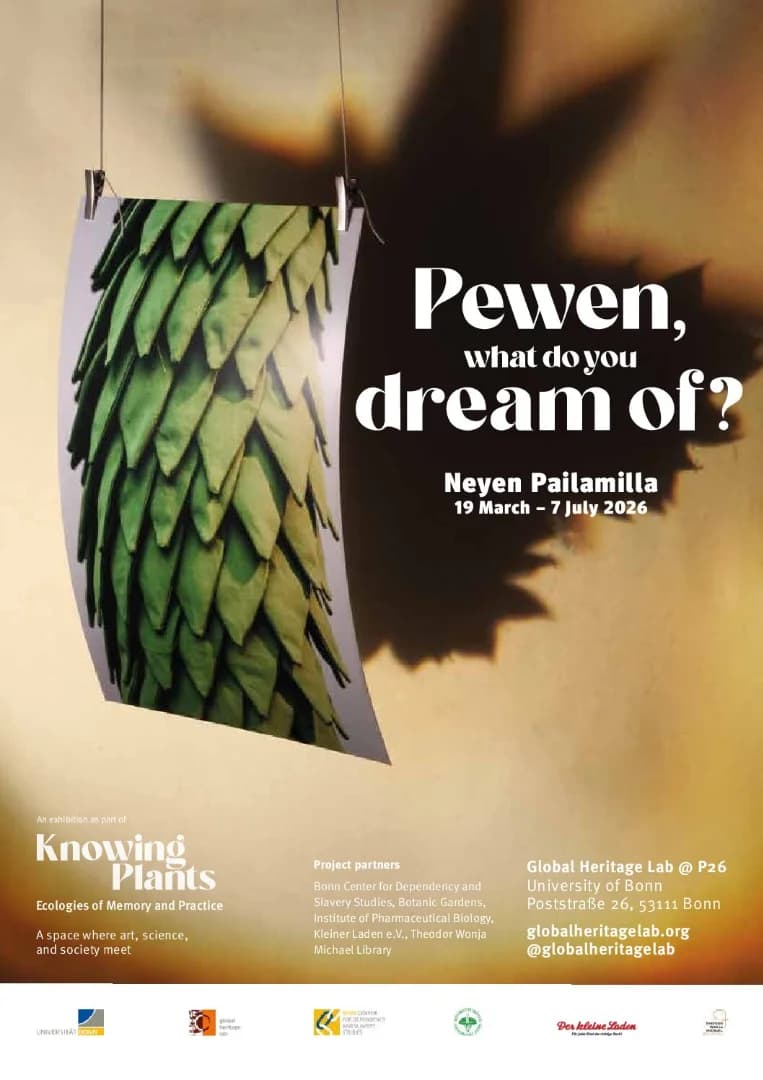
Am 19. März eröffnet Neyen Pailamilla den Ausstellungszyklus mit Neyens Performance „Transplant: Healing in the Mapuche Diaspora“. Die Performance beginnt im Botanischen Garten und beleuchtet den Dialog zwischen Natur- und Kulturwissenschaften, Kunst und Gesellschaft sowie Mensch und Umwelt.
Im Mittelpunkt des ersten Kapitels „Frühling: Wovon träumt Pewen?” steht Neyen Pailamillas künstlerisches Schaffen. Mehrere partizipative Elemente begleiten das Kapitel. Im Duftlabor, das in Zusammenarbeit mit dem Institut für Pharmazeutische Biologie entwickelt wurde, können Besucher den Duft des heiligen Mapuche-Baums Pewen erkunden. Zwei Leseecken, kuratiert von der ersten Schwarzen Bibliothek in Nordrhein-Westfalen, der Theodor-Wonja-Michael-Bibliothek, und von der Kinder- und Jugendbuchhandlung „Kleiner Laden“ e. V., laden zum Verweilen, Stöbern und Nachdenken ein.
ENG:
What forms of knowledge shape the ways we relate to plants and our environment – and how can we create sustainable relationships with them?
The exhibition invites visitors to engage with historically shaped relationships with plants, ecosystems, and waters, and to reflect together on more responsible ways of engaging with the environment.
Across the four seasons, artists with family connections to Chile, Australia and New Zealand, Nigeria, Mauritius, India, and Jamaica enter into dialogue with researchers from the University of Bonn and members of the city’s wider community. Together, they create a space for learning and encounter that explores questions of sustainability, memory, and transformation from transdisciplinary perspectives.
On 19 March, Neyen Pailamilla will open the exhibition cycle with their performance Transplant: Healing in the Mapuche Diaspora. The performance begins in the Botanic Gardens, highlighting the dialogue between natural and cultural sciences, art and society, and humans and the environment.
Neyen Pailamilla’s artistic work is also the focus of the first chapter, Spring: What Does Pewen Dream Of? Several participatory elements accompany the chapter. In the fragrance laboratory – developed in collaboration with the Institute of Pharmaceutical Biology – visitors can explore the scent of the sacred Mapuche tree, Pewen. Two reading areas, curated by the first Black library in North Rhine-Westphalia, the Theodor Wonja Michael Library, and by the children’s and young people’s bookshop Kleiner Laden e.V., invite visitors to linger, browse, and reflect.
The exhibition is supported by the Bonn Center for Dependency and Slavery Studies.
We look forward to welcoming you and to the conversations the exhibition will inspire.